
The Extraordinary Journey of the Whale Without a Tail
Written by Maddalena Jahoda
She used to be the mascot of researchers and whale watchers in the Pelagos Sanctuary, a large marine protected area in the northwestern Mediterranean. A female fin whale (Balenoptera physalus), she was instantly recognizable for two reasons: unlike other fin whales that visit the area mainly in summer during their feeding season, she would lift her tail out of the water when diving. And most notably, of her two flukes, one was almost entirely missing.
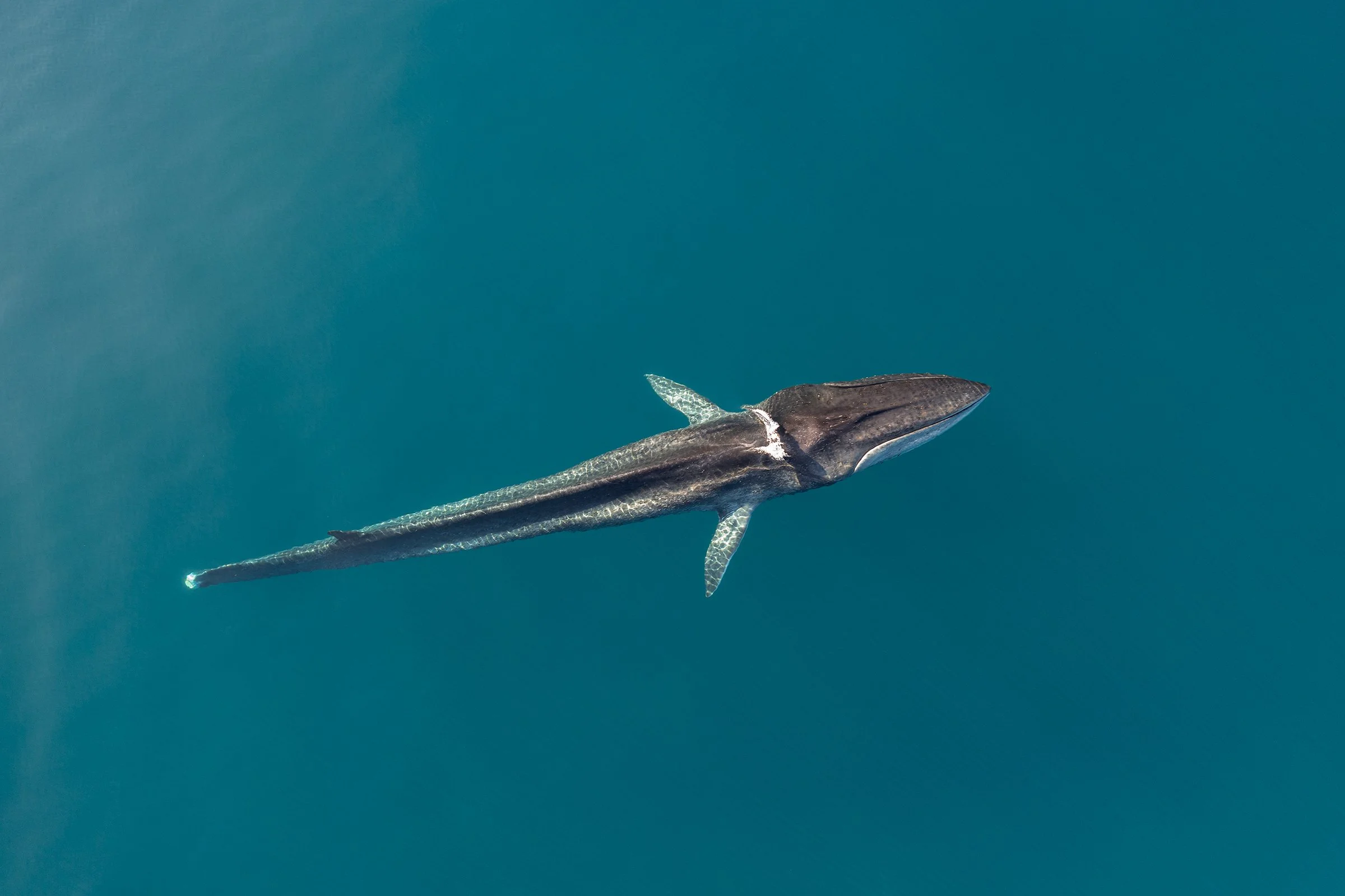
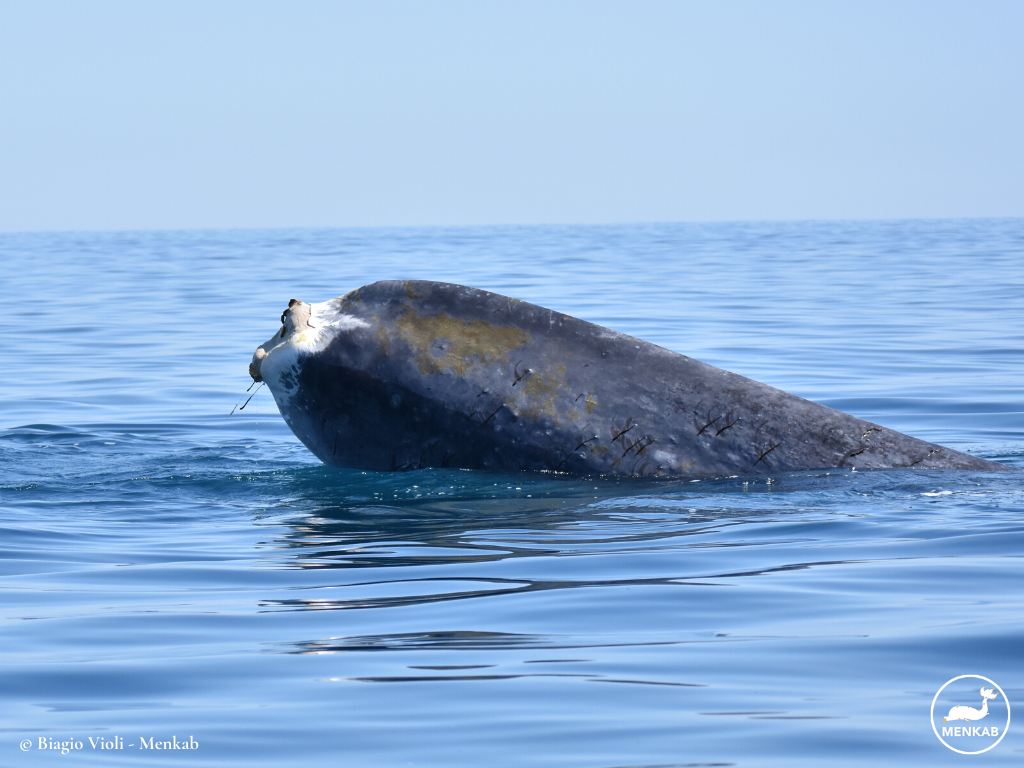
But that was only the beginning of the story of “Codamozza”— as we called her in Italy, or “Fluker” in other countries—an incredible story that would also touch me personally. The missing part of her tail, most likely the result of a collision with a boat, didn’t seem to hinder her in any way. Along with many others, whale watchers and boaters, we used to sight her regularly for 24 years. Then, in 2019, something happened that no one could have imagined. Researchers from Greece reported a fin whale swimming with no tail at all. Fin whales can be photo-identified by the white pattern on the right side of their head and other distinctive body markings. It wasn’t hard to find her in the “catalog” of whales sighted in the Sanctuary by the Tethys Research Institute, where I have worked for nearly 40 years: it was Codamozza. Against all odds, she had suffered a second accident.
For a short time, Codamozza became famous. After being seen in Greece, she appeared in southern Italy, then traveled north along the country’s western coast, returning to the Pelagos Sanctuary, which she clearly considered her home. She still swam the same way, raising what was now a striking stump from which the bone of her last vertebra could be seen. Her story was picked up by newspapers and television, both in Italy and abroad. As part of my role at the Tethys Research Institute, where I am responsible for scientific outreach, I also acted as a “press officer” for the whales, getting requests from France, Austria, and even the UK for updates on the unlucky animal.
Unexpectedly, Codamozza also proved to be a valuable asset for research. While most fin whales look the same at first glance, she was unmistakable to anyone, which allowed us to follow her movements for nearly a year. Alongside a large group of whale scientists, we reconstructed piece by piece her recent history. Codamozza was most likely injured off the French Riviera, where fishermen photographed her with long strips of blubber hanging from the sides of her caudal peduncle — a sign that the injury was recent. Ironically, this stretch of sea lies within the Pelagos Sanctuary itself, created with the best intentions for cetacean protection, but which must still contend with heavy human presence, pollution, fishing, and some of the busiest shipping lanes in the world.

By the end of summer, Codamozza, as perhaps was her usual habit, began moving south from the Sanctuary along the Spanish coast. In winter, she disappeared from sight: there are fewer boats at sea, and in the area she was likely traveling—along the African coast—whale and dolphin surveys are rare. Then in May, Codamozza was unexpectedly spotted off Syria, at the easternmost point of the entire Mediterranean. She had set a record: the first documented case of a fin whale from the Pelagos Sanctuary sighted in the Levantine Basin.
In just nine months, between September 2019 and early July 2020, Codamozza traveled at least 7,000 km. Swimming along the coast rather than in the open sea as her species typically does, she may have taken advantage of currents. But her journey, which traced the entire perimeter of the Mediterranean, was nonetheless extraordinary. It ended where Codamozza seemed to feel most at home,the Pelagos Sanctuary. She was last seen in the Gulf of Toulon, exhausted, shockingly thin, her spine protruding unnaturally from her back.
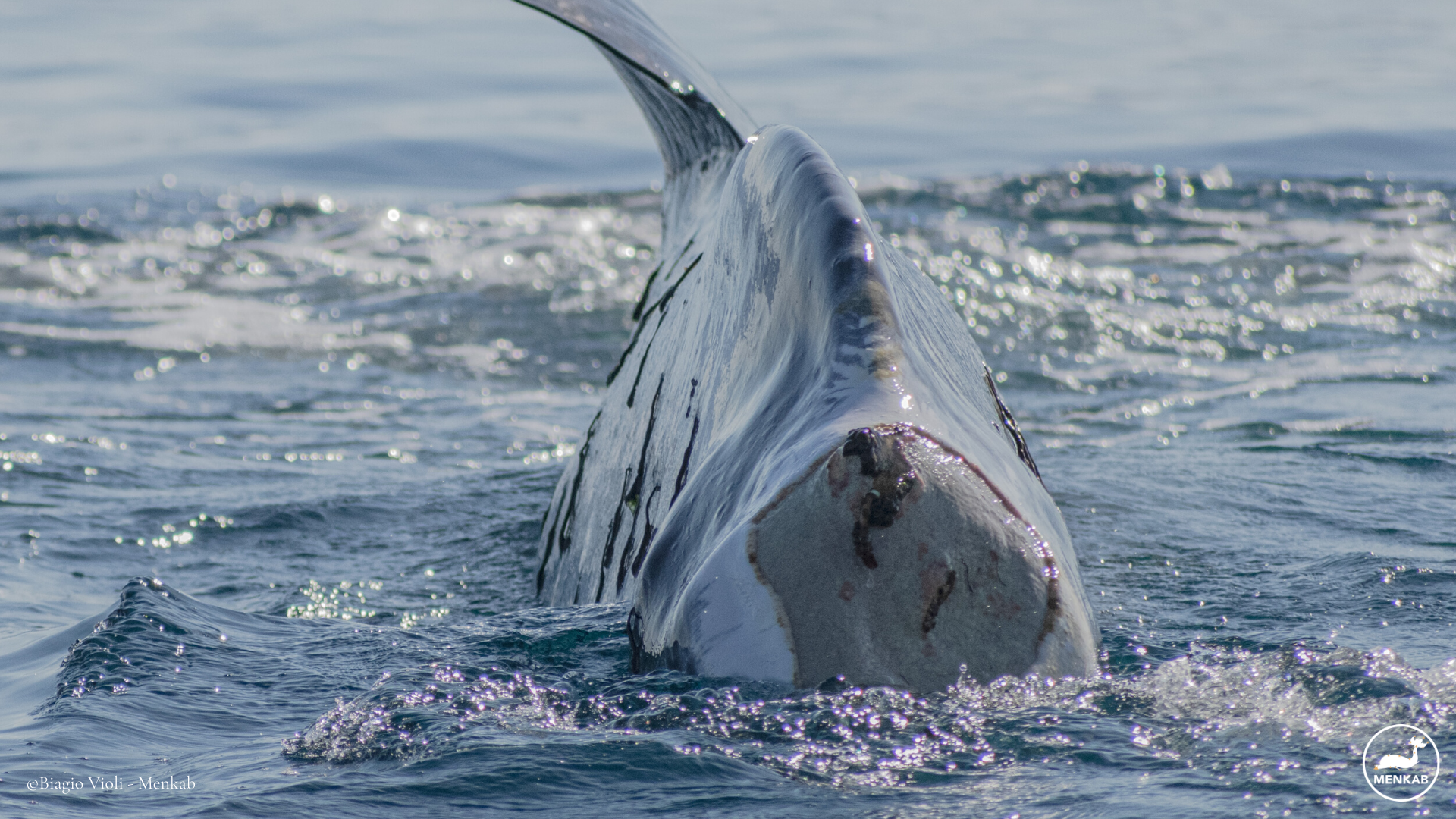
An extremely rare case? Yes, but certainly not unique. In scientific literature, we found reports from around the world of 44 other live whales with amputated tails, plus 26 additional cases of dead animals. These incidents mainly involved coastal species, such as humpback and gray whales. Most cases were documented in the Americas. not because they don’t happen elsewhere, but likely because some areas are monitored more closely than others. And there are other cases in the Mediterranean we have witnessed in recent years: from a fin whale with only a narrow strip of tail remaining, to a sperm whale whose tail was so shredded that people on social media claimed it had to be fake. Sadly, “Atlante’s” tail is all too real—as is “Propeller’s” scar and “Stripes’” recent, terrible wound.
In the Mediterranean, the numbers today are alarming: between 6% and 20% of fin whales in the northwestern Mediterranean bear scars from ship strikes—a figure that doesn’t include those injured or killed without anyone noticing. Each year, it’s estimated there are around 3,000 near misses with high-speed vessels—and above 10 knots, the risk increases significantly. Scientists believe this level of mortality is no longer sustainable for the Mediterranean population.
This is our main concern as researchers, and the reason behind so many studies. But there’s more: it is not simply a matter of addressing mortality causes or merely maintaining population status, if survival means that these animals must constantly struggle against awful threats. Some of us also believe that humans bear a moral obligation to prevent extreme suffering in animals, thereby averting dramatic accidents like Codamozza’s—probably among the most painful and disabling events that can happen to a whale.
I felt compelled to tell Codamozza’s story both to the public and to the scientific community (*) so that it will not be forgotten,and so that it will not happen again. At the very least, we owe her that.
(*) Jahoda, M., Zanardelli, M., Dhermain, F., Alessi, J., Armonio, F., Ballardini, M., Barcelo, A., Calogero, G., Fontanesi, E., Frantzis, A., Menniti, M.A., Monaco, C., Obadia, C., Pellegrino, G., Raffa, A., Tardy, C., Verga, A., Violi, B., Panigada, S. (2025). Codamozza‐Fluker: The Compelling Case of a Flukeless Fin Whale Traveling Throughout the Mediterranean Sea and the Need for Basin‐Wide Conservation Efforts. Ecology and Evolution, 15(5). https://doi.org/10.1002/ece3.71313
Maddalena Jahoda
From the start of her career, she has believed that research must serve species conservation and actively involve the public. A biologist and journalist, she has worked in cetacean research and outreach for nearly 40 years. She began with nature magazines and documentaries, and since the founding of the Tethys Research Institute, she has been dedicated to protecting Mediterranean marine mammals. She also is in charge for the Institute’s scientific outreach efforts.